
LUNCH WITH EDNA
The purpose of Lunch with EDNA is to:
- provide instructors with free and local professional development of teaching across our post-secondary institutions in Alberta
- create an opportunity for instructors to share ideas across institutions
- highlight the educational leadership of EDNA members who facilitate
On the third Wednesday of every month, an EDNA member will lead a session on a topic that is relevant and practical for instructors at colleges, universities, institutes, and polytechnics to implement in their teaching and learning contexts. The format may be a presentation, discussion, workshop, case study, demonstration, or telling and unpacking a a teaching experience.
UPCOMING LUNCHES
We look forward to seeing you at our 2025-26 sessions! Learn more and register below

Designing for Experience: Strategies to Embed Experiential Learning in Postsecondary Teaching
February 18, 2026 | 12:05 to 12:50 pm | Online
Facilitator: Dr. Michelle Anderson-Draper, EdD, CE, Instructional Designer, University of Alberta
Have you been wondering about how to incorporate more experiential learning (EL) into your institution’s programming? Participants will explore the principles of EL and discover practical strategies to embed those principles into their course. Through examples and discussion, the session will highlight how EL can deepen student engagement, strengthen connections between theory and practice, and enhance learning outcomes. Participants will leave with ideas and a list of resources for integrating EL approaches in their institutional contexts.
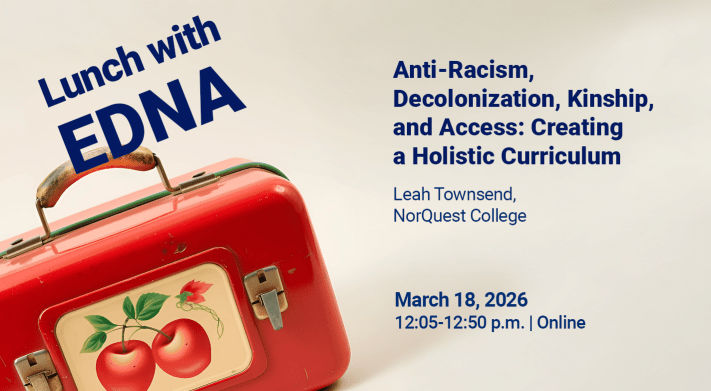
Anti-Racism, Decolonization, Kinship, and Access: Creating a Holistic Curriculum
March 18, 2026 | 12:05 to 12:50 pm | Online
Facilitator: Leah Townsend, Education Developer, Norquest College
How do you create a curriculum that reflects the society you want to live in? And then balance that curriculum with institutional priorities and goals? Join us to learn about a unique curriculum development guide created by NorQuest College. The guide combines research-based best practice with the guiding lenses of Anti-Racism, Decolonization, Kinship, and Access to support the creation of curriculum that reflects not only what we want our students to learn, but how we guide them to grow as people. You will see how the guide has been used in practice, and get some ideas for adapting the guide to your own program and institution.
PAST LUNCHES

Confident grading: Aligning assessment with Learning
January 21, 2026 | 12:05 to 12:50 pm | View Recording
Facilitator: Amy Christiansen, Manager/Faculty Support and Academic Resources, Olds College
Ever look at your gradebook and wonder if the grades actually show what your students learned? Do you ever tremble when hitting submit on grading hoping your students won’t ask you hard questions about their grade? You’re not alone.
Join us for this practical online session where we’ll explore ways to strengthen the connection between our assessments and student learning. We’ll focus on designing assessments that give us confidence the grades we assign truly reflect what students know and can do. Bring your gradebook questions and your ideas to tackle this together!

Supporting EAL learners in your classroom
November 19, 2025 | 12:05 to 12:50 pm | View Recording
Facilitator: Annemarieke Hoekstra PhD, Educational Developer, NAIT
This session is for instructors from all disciplines and fields who are interested in enhancing their strategies to teach, support, and/or communicate with learners whose home language is not English. These learners are also called English as Additional Language (EAL) learners. EAL learners are learning how to be a student, learning your course content, and are still learning English all at the same time. EAL learners may have difficulties with speaking speed, accent, cultural references, jargon, complex words, reading comprehension and more. Session participants will leave the session ready to implement strategies to support EAL learners.
View Recording: Do you have students in your class whose home language is not English?

Think before you upload: What faculty and students need to know about academic file-sharing sites and AI platforms
October 15, 2025 | 12:05 to 12:50 pm | View Recording
Facilitators: Brooklin Schneider, Educational Developer, NorQuest College and Lauren Cross, Writing and Learning Specialist at Mount Royal University.
This workshop explores the intersection between third-party academic-file sharing websites and generative AI tools, including “checker” and “detector” tools,” focusing on implications for data privacy, intellectual property, and academic integrity. Faculty will gain practical insights into how these tools collect and use data, the implications for student work, and strategies to address these integrity challenges in their courses.
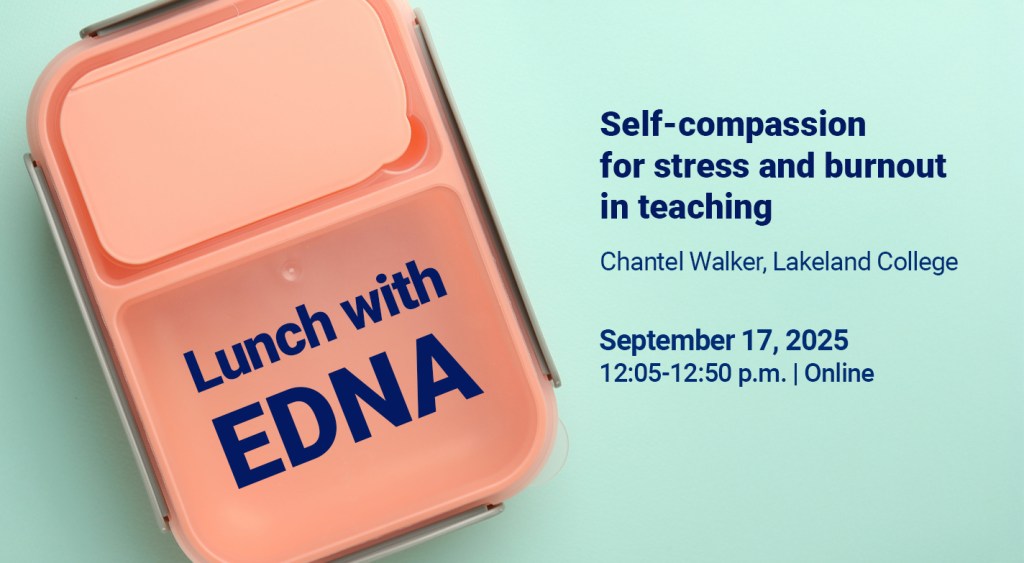
Self-compassion for stress and burnout in teaching
September 17, 2025 | 12:05 to 12:50 pm | View Recording
Facilitator: Chantel Walker, Teaching and Learning Commons, Lakeland College
This workshop is designed to help individuals recognize, manage, and prevent burnout through self-compassion strategies, mindfulness techniques and boundary setting. Participants will gain practical tools to restore balance and enhance overall well-being including: identifying signs and causes of burnout and stress in teaching; practicing mindfulness techniques and self-compassion practices to reduce stress; and setting healthy boundaries in teaching.

Indigenous Talking Circles in Online Learning
Wednesday, March 19, 2025 | View recording
Facilitators: Dr. Aubrey J. Hanson, PhD. Associate Professor and Director, Indigenous Education Curriculum & Learning | Werklund School of Education
Dr. Patricia Danyluk, PhD. Associate Professor Werklund School of Education
Dr. Julie Mooney, PhD Educational Developer, Faculty Member Centre for Academic Development and Innovation Southern Alberta Institute of Technology
This Lunch with EDNA features the co-authors of the article Indigenous Talking Circles in Online Learning, Dr. Aubrey Hanson and Dr. Patricia Danyluk, co-facilitating with EDNA member and Educational Developer, Dr. Julie Mooney. In this session, we will discuss the article, asking questions about using talking circles as Indigenous pedagogy in online education. We will consider how Indigenous pedagogy ameliorates the often disconnected experience of online environments for learners, while also critically exploring the risks and tensions of bringing circle work—which arises from experiential ways of knowing, being, and doing—into a virtual setting. As teacher educators and educational developers teaching in online environments, we draw from our own pedagogical approaches and bring our experiences into dialogue with critical scholarship on Indigenous education and circle work.
Video recording | Presentation slides

Approaches and Tips for Facilitating Messy or Challenging Conversations in the Classroom
Wednesday, February 26, 2025 | View recording
Facilitator: Mandy Penney (she/her) Lead Educational Developer, University of Alberta
At this challenging moment of intersecting local, national, and global crises, we know that the stress and trauma of “external” forces make their way into the classroom. This session will introduce the relationships between the following frameworks: students-as-whole-people, students-as-partners, and trauma-informed teaching. Together, the facilitator and participants will consider concrete approaches to preparing for, facilitating, and reflecting on these potentially tense or uncomfortable moments in classroom communities.

Imposter Syndrome in Teaching
Wednesday, January 15, 2025 | 12:05 to 12:50 pm
Facilitators: Dr. Cosette Lemelin, EDNA Chair and Assistant Director, Centre for Teaching and Learning, University of Alberta & Dr. Jeff Kuntz, Faculty Developer, Norquest College
In teaching literature, imposter syndrome is identified as stage fright, fear of public speaking, communication apprehension, and a type of performance anxiety. These feelings can be uncomfortable (even debilitating) for instructors until, with more experience and skill, they can be managed. In January’s Lunch with EDNA, you’ll take away strategies to overcome imposter syndrome.

Play in Higher Education Teaching and Learning
Wednesday, November 20, 2024 | 12:05 to 12:50 pm | Online
Facilitator: Mabyn Grinde, Faculty Development Coordinator, Lakeland College
Students and instructors alike are tired by late November. How can instructors boost morale and bring positive energy and fun in the final weeks of the term? At this month’s Lunch, Mabyn explores the numerous benefits of play in higher education and demonstrates some brief fun playful activities instructors can do with their students. Come have some fun engaging in pedagogical play, it’s good for you!
Video recording | Presentation slides

Universal Design for Learning in Conversation with Generative AI
Wednesday, October 23, 2024 | 12:05 to 12:50 pm | Online
Facilitator: Flora Mahdavi, Learning Design Consultant & Jennefer Rousseau, English Instructor, Bow Valley College
Because Generative Artificial Intelligence (GenAI) has led to concerns for academic integrity, some instructors are restricting assessment requirements, such as timed, invigilated exams over more flexible forms of assessment. This poses challenges for students with special physical or cognitive needs who require accommodations. At October’s Lunch, instructors examine (a) the impact of artificial intelligence, as an enabler or inhibitor, on UDL practices, and (b) practical teaching and assessment strategies in GenAI in line with UDL. Instructors will have an opportunity to share their effective UDL practices in the era of GenAI.
Video recording | Presentation slides
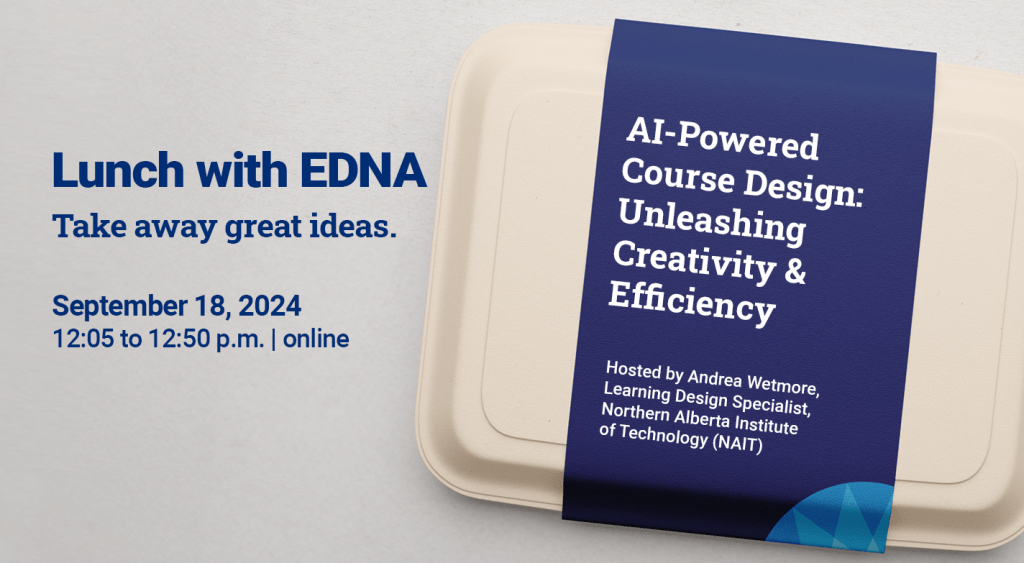
AI-Powered Course Design: Unleashing Creativity & Efficiency
Wednesday, September 18, 2024 | 12:05 to 12:50 pm | Online
Facilitator: Andrea Wetmore, Learning Design Specialist, Northern Alberta Institute of Technology (NAIT)
At September Lunch, Andrea will delve into the practical applications of Generative AI in course design. Instructors will explore how to leverage AI, specifically ChatGPT, as a personal assistant to streamline various aspects of course development, including generating delivery plans, designing lessons and activities. Instructors will learn how to effectively utilize AI tools while still retaining human input for critical aspects such as contextualization and refinement. By the end of the session, instructors will have gained practical skills and insights into integrating AI seamlessly into their course design process.
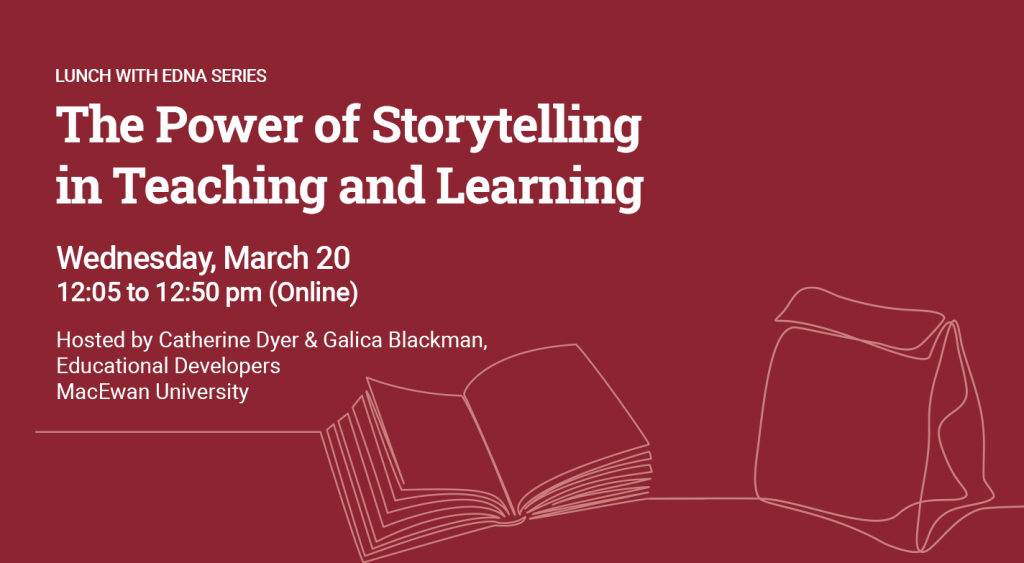
The Power of Storytelling in Teaching and Learning
Wednesday, March 20, 2024 | 12:05 to 12:50 pm | Online
Hosted by:
Catherine Dyer & Galica Blackman, Educational Developers
MacEwan University
Since the beginning of time, we have gathered to tell stories. From sitting around a campfire to YouTube shorts and TikTok and Instagram reels, stories have the power to foster empathy, compassion, and reflection. Catherine and Galicia invite you to share your story and learn from the stories of others. We will explore practical ways instructors and their students can use storytelling to get at hard to teach, challenging to learn, affective outcomes in meaningful and relevant ways.
Meaningful Feedback for Learning
Wednesday, February 21, 2024 | 12:05 to 12:50 pm | Online
Hosted by:
Marjorie Contenti, Learning Design Consultant
Bow Valley College
Meaningful feedback nourishes students and helps them grow and improve no matter the post-secondary institution or field of study. In this month’s Lunch with EDNA, Marjorie Contenti distinguishes between bites of effective feedback and a glut of confusing advice, including: How much feedback can students digest in one sitting? How do instructors decide what feedback will be most useful? What principles of offering feedback are essential in the instructor role?
Video recording | Marjorie’s slides | Extra resources from Marjorie

Teaching Strategies for Learning in/across a Variety of Physical Learning Spaces
Wednesday, January 17, 2024 | 12:05 to 12:50 pm | Online
Hosted by:
Patrick Kelly, Manager, Learning and Instructional Design
Dr. D’Arcy Norman, Associate Director, Learning Technology and Design
Taylor Institute for Teaching and Learning, University of Calgary
Similar to restaurant dining, the configuration, atmosphere and use of a physical learning space can impact comfort, mood, and enthusiasm for the meal or class. When instructors are assigned to a wide variety of physical learning spaces ranging from large lecture halls, to seminar rooms, to studios or off-campus spaces, how can they leverage these spaces for effective student engagement and learning? What strategies can instructors use to prepare their courses with the learning space in mind? During this session participants will be asked to share the types of spaces at their own institutions and from that list we will break into small groups to discuss strategies and challenges of teaching in those spaces. To conclude, we will generate a collection of these strategies to share back to participants and their colleagues.

Feasting on the Future of Assessments with ChatGPT
Wednesday, November 15, 2023 | 12:05 to 12:50 pm | Online
Prepare your taste buds as we dig into the transformative power of Chat GPT in crafting modern assessments that will leave your students hungry for knowledge. This Lunch with EDNA hosted by Jonas Couture (Education Multimedia Specialist, Red Deer Polytechnic) will satiate your appetite for innovative teaching methods, dive into the savory depths of AI-generated assessment creation, and leave you craving for the possibilities of AI as a tool for student learning.
Video recording
Co-creating a LearnerAgreement: Improving Learner Accountability in your Course
Wednesday, October 18, 2023 | 12:05 to 12:50 pm | Online
Much like a good appetizer, learner contracts or agreements are commonly served by the instructor at the start of the course to whet students’ appetite for the main course and set the tone. In October’s Lunch, hosts at the Northern Alberta Institute of Technology (NAIT) Tino Villatoro (Curriculum and Instruction Specialist) and Angie Skuba (Teaching and Learning Specialist) share experiences co-creating learner agreements with students to ensure more accountable, productive, and engaging learning environments. If instructors and their students agree on the flavour of the course and hold each other to this agreement, the course is more likely to be successful for all.

Multiple Choice Questions for Applying, Analyzing, & Evaluating Student Learning
Wednesday, September 20, 2023 | 12:05 to 12:50 pm | Online
Join us for Lunch with EDNA where the University of Alberta’s Anita Parker (Lead Educational Developer, Centre for Teaching and Learning) will set the table with the merits and limitations of traditional multiple-choice questions (MCQ), then dish out examples of MCQ requiring students to go beyond remembering to apply, analyze, and evaluate. If writing MCQ are on your Whine List, come join us for Lunch!
 eddevelopernetworkalberta.ca